Hungarian history as an ultra-graph
Having trained a 1-bit language model on Anonymus, I had the Gesta Hungarorum on the brain — the origin story, Álmos and Árpád and the seven chieftains coming out of Scythia. And the library I built it on, ultragraph, is not really an ML library; it is a graph library that happens to be able to be a language model. So the obvious next move: stop training on Hungarian history and just draw it — the whole arc, as one graph, in the byte-graph data model itself.
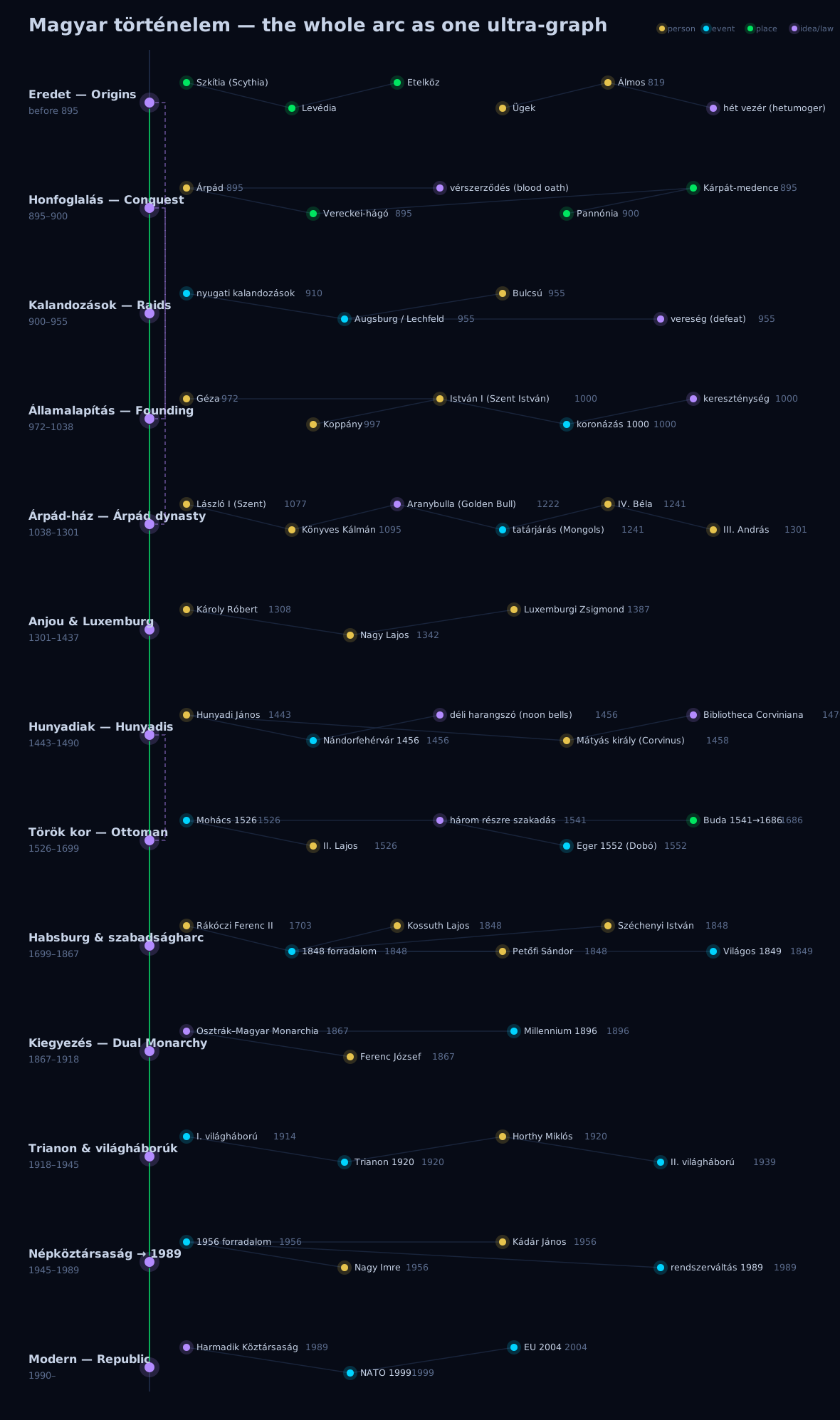
history is a graph, so store it as one
The ultragraph data model has exactly the three levels history wants:
- a node is one byte — here, one person, event, or place;
- a tree is a whole sub-graph — here, one era;
- an ultra-edge (
===) wires trees together — here, the arrow of time.
So each era of Hungarian history is a sparse Tree. Its nodes are the people, events, and places that matter — Álmos, Mohács 1526, Vereckei-hágó — carried with their labels and years in the tree's ad-hoc side store (the byte-graph keeps one byte per node for the machine; the ad-hoc store keeps the human-readable extra data). Within an era, micro-edges wire the relations: father of, defeats, leads to, crowned. Between eras, ultra-edges wire the chronology — Origins >> Conquest >> Raids >> Founding >> … — one arrow per turn of the age.
ug = UltraGraph("hungarian_history")
trees = []
for key, span, nodes, edges in ERAS:
    t = Tree(len(nodes), name=key)
    t.adhoc["labels"] = nodes          # the ad-hoc side store: people / events / places
    for a, b, rel in edges:
        t.add_edge(a, b, 1)            # a micro-edge — one byte — inside the era
        t.adhoc["rels"][(a, b)] = rel
    ug.add(t); trees.append(t)
for prev, cur in zip(trees, trees[1:]):
    prev >> cur                        # ultra-edge (===) — the arrow of time
The result is one UltraGraph: 13 era-trees, 59 nodes, 45 micro-edges, 15 ultra-edges. The whole of Hungarian history, from before 895 to the EU, as a single byte-graph you can hold in one object.
the residual links
Chronology is the backbone, but history rhymes, so a few ultra-edges are typed residual instead of plain — the dashed purple brackets on the left of the diagram. They carry a signal across the centuries rather than step to step:
- Origins → Founding: the Árpád line that Anonymus traces from Álmos is the same line that puts the crown on Saint Stephen in the year 1000.
- Conquest → Árpád dynasty: the land taken in 895 becomes the kingdom that holds it for four hundred years.
- Hunyadi → Ottoman: the Hunyadis' victory at Nándorfehérvár in 1456 buys the seventy years that end at Mohács in 1526.
Residual edges are the same primitive the transformer blocks use to carry a signal past a layer. Here they carry it past a century. Same ===, longer reach.
the same substrate as the LLM
This is the part I find quietly satisfying. The Origins era at the top of the graph — Scythia, Levédia, Etelköz, Ügek, Álmos, the hetumoger — is exactly the material of the Gesta Hungarorum, the text the 1-bit Anonymus LLM was trained on. The graph and the language model are two readings of the same byte-graph substrate: one stores history as nodes and typed edges you can see; the other compresses a chronicle of it into ternary weights you can run. Node, edge, tree, ultra-edge — it renders a timeline or it writes medieval Latin, depending on which way you squint.
The graph here is semi-static — hand-curated, not learned. That is the honest label: it is a knowledge graph, a scaffold, the kind of thing you would hand to a model as ground truth rather than ask it to hallucinate. The interesting future is wiring the two together — the learned model reading and extending the curated graph — but that is a later post.
reproduce
pip install ultragraph-1bit
uv run python examples/hungarian_history.py
# -> examples/data/hungarian_history.svg (this timeline)
#    examples/data/hungarian_history_macro.svg (the library's own ultra-graph view)
The renderer is ~120 lines of pure Python emitting SVG — no dependencies beyond the library. Fork it, add your own eras, or point it at a different nation's arc; the data model does not care whose history it is.
Further reading
- ultragraph on GitHub — the byte-graph library. The history graph is
examples/hungarian_history.py. - The first 1-bit Hungarian LLM — a ternary GPT trained on Anonymus, the source of the Origins era.
- anonymus-1bit-gpt on Hugging Face — the trained 196 KB model.
- ultragraph — when the graph is the 1-bit LLM (part 1) — node = byte, edge = trit, tree = net,
==== ultra-edge.