ultragraph — when the graph is the 1-bit LLM
I built a small thing today that I like a lot: ultragraph, a graph library where the graph is the model. Not a graph that describes a network — the graph, byte for byte, is a 1-bit (ternary) LLM you can train and run.
Repo: github.com/peterlodri-sec/ultra-graph. Genesis commit 251e6ea.
The constraint I started from was deliberately silly: one byte per node, one byte per edge. A node stores an int8 activation. An edge stores a ternary weight in {-1, 0, +1}. That's it. Everything bigger than a byte — the full-precision master weights, the gradients, the optimizer state — lives in an ad-hoc side store and never touches the hot path. The byte buffers are the deployed model; the side store is just scaffolding for training.
three levels
The hierarchy is the whole idea:
- node / edge — 1 byte each. The micro level.
- tree — a whole graph. One self-contained module: a linear layer, an attention block.
- ultra-edge (
===) — a typed connection between trees. The set of trees plus their ultra-edges is the ultra-graph — the full model.
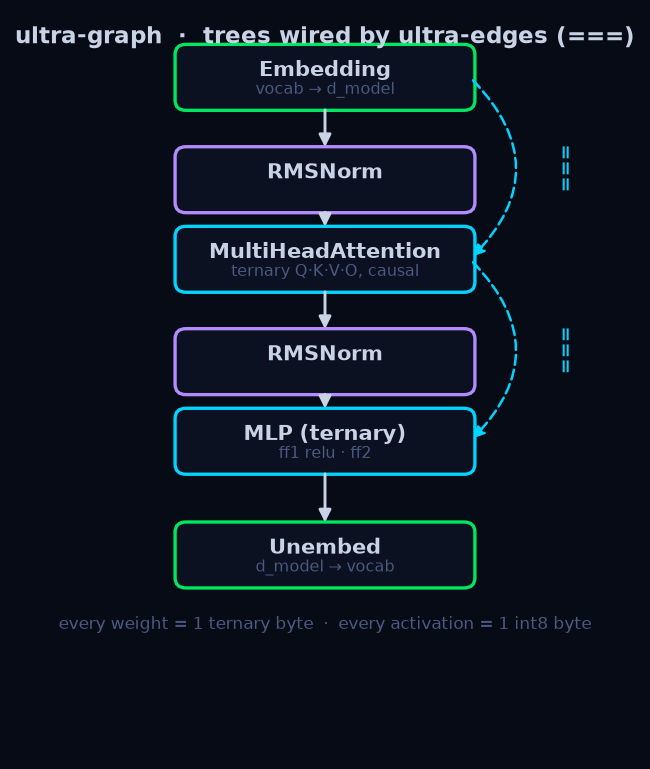
The API leans all the way into Python dunder methods, because that's the fun part. >> is overloaded by operand type: node >> node builds a micro-edge inside a tree; tree >> tree builds an ultra-edge between trees. Same "flows into" idea at both scales.
ug = UltraGraph()
a = ug.add(Tree.dense(64, 128, "a"))
b = ug.add(Tree.dense(128, 32, "b", act="none"))
a >> b                 # ultra-edge, plain
a.wire(b, "residual")  # residual skip
ternary, the BitNet way
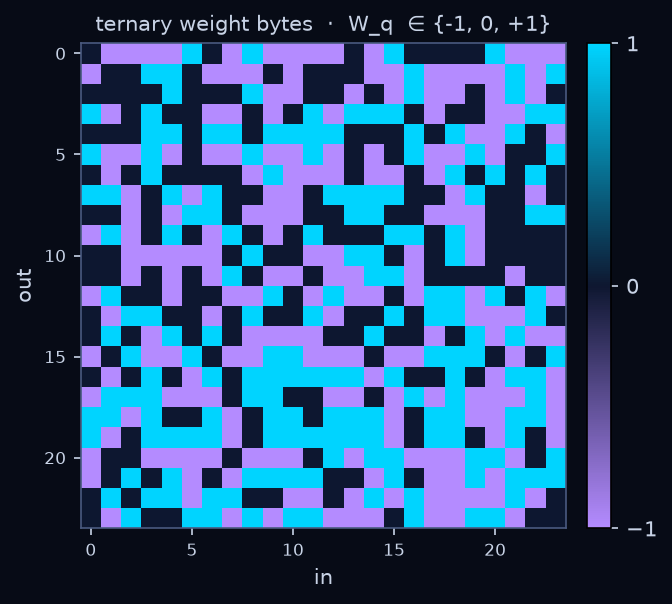
Weights are ternary and activations are int8, BitNet b1.58 style. Forward quantizes; backward uses a straight-through estimator so gradients flow to the full-precision masters as if the quantization were the identity. The autograd is a little reverse-mode tape over numpy — micrograd energy, but the ops are tensor-level and everything is quantized.
Here's a real trained query-projection's weight matrix. Every cell is one byte, one of three values:
it does attention
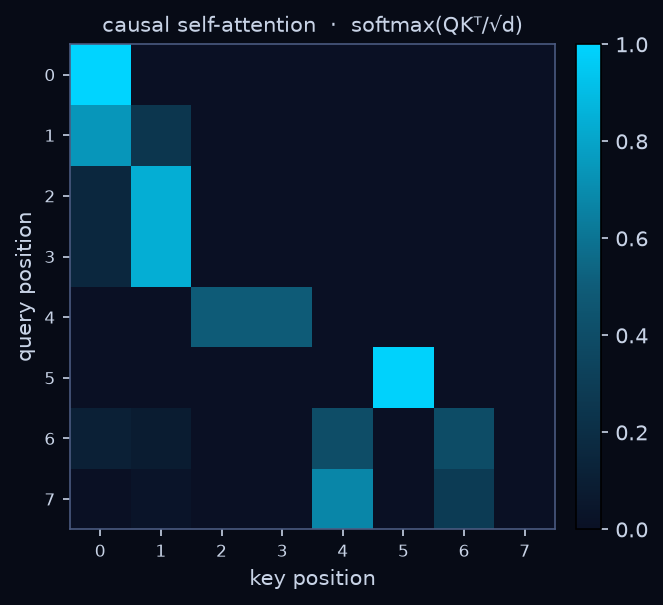
The engine is general, so a transformer falls out of it. I added single-head, then batched multi-head causal self-attention, RMSNorm and LayerNorm, and Adam with gradient clipping. The attention needed a couple of new autograd ops — batched matmul, swapaxes, reshape, axis-mean, sqrt, division — but once those existed the block is just the usual softmax(QKᵀ/√d) · V with a causal mask.
The one subtlety worth flagging: I quantize activations per token (per row), not per tensor. With a global activation scale, perturbing a later token would shift the quantization of earlier tokens, and causality quietly breaks. Per-row scaling keeps each position independent. Here's the real attention matrix from a forward pass — strictly lower-triangular, which is exactly the point:
A tiny batched transformer (embedding → pre-norm attention + residual → pre-norm MLP + residual → unembed) trains cleanly. On a toy char corpus it drops from loss 2.63 → 0.13 in a few hundred Adam steps and samples back hello ultra graph world hello hello ultra graph. It memorized. Good enough for a byte-graph.
how it got built
This is the building-in-public bit. I ran it as a brainstorm → design → implement loop and did most of the fan-out work through caveman subagents: builders that emit one focused file at a time, reviewers that read the diff and report only real bugs. The reviewers earned their keep — they caught a genuine topological-order bug in the forward pass, a NaN-scale edge case in the quantizer, and a module-index misalignment in save/load. The correctness-critical numerical core I wrote by hand, because that's where subagents drift.
Everything is pure Python plus numpy, managed with uv, Python 3.14. 43 tests pass (numeric-gradient checks on every op, a causality proof, save/load byte-exactness, and end-to-end training). Snyk came back clean.
just test— full suitejust demo/uv run python examples/mini_gpt.py— the transformer end-to-endjust viz— render the graph as SVG or PNG
The figures in this post were generated from an actual trained model (assets/make_figures.py), not mocked up. That felt important: if the claim is that the graph is the model, the pictures should be the model too.
Genesis 251e6ea. It's small, it's honest, and every weight is a single byte.